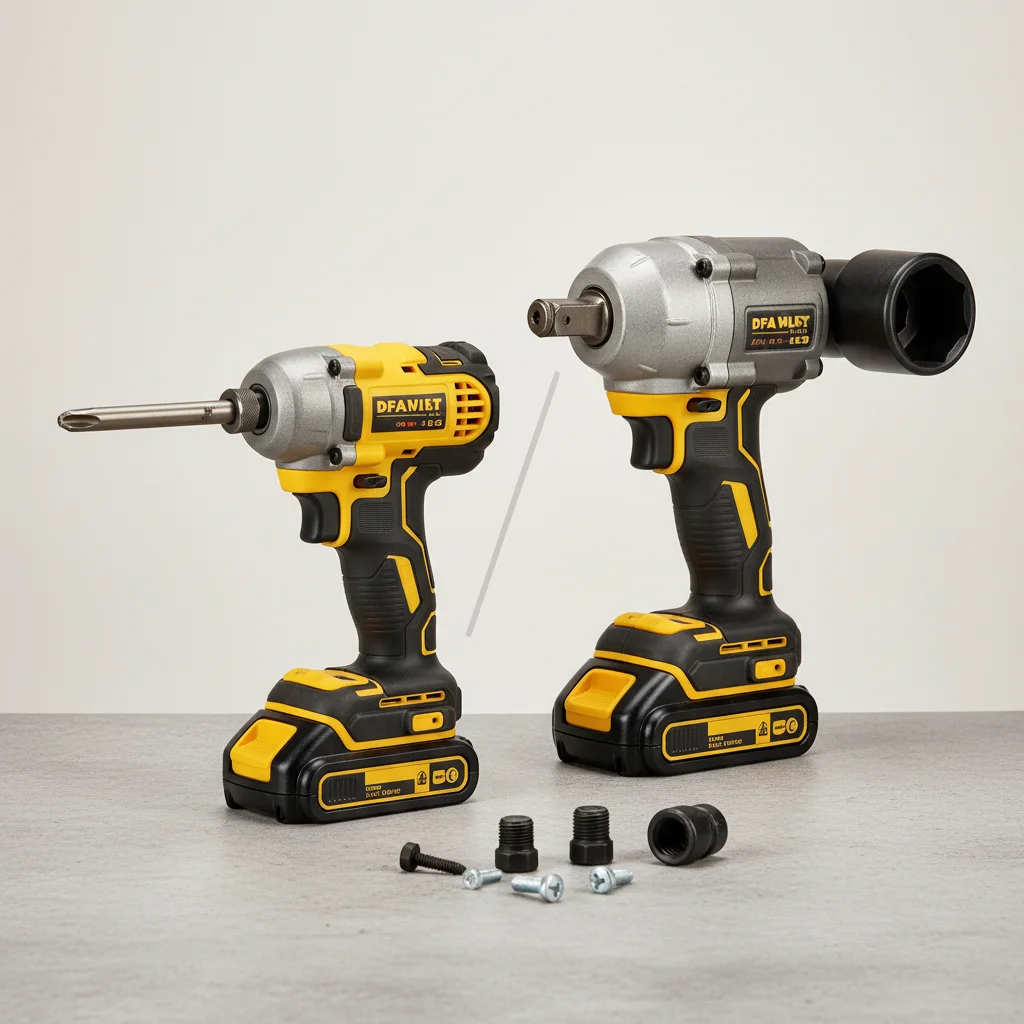
Choosing between an impact driver and an impact wrench depends entirely on the task at hand, with each tool excelling in different applications. An impact driver is primarily designed for driving screws and fasteners into wood or metal, offering high rotational force for efficient fastening. In contrast, an impact wrench is built for heavy-duty fastening and loosening of nuts and bolts, commonly found in automotive repair and construction, delivering significantly higher torque.
Understanding Impact Drivers
Impact drivers are compact, lightweight tools that deliver short, powerful bursts of rotational force, known as impacts, to drive fasteners. This impact mechanism prevents cam-out and reduces user fatigue, making them ideal for repetitive tasks like deck building, cabinet installation, or assembling furniture. They typically use 1/4-inch hex shank bits, which are perfect for screws, lag bolts, and small to medium-sized fasteners. Their design prioritizes speed and precision for fastening applications.
The internal mechanism of an impact driver involves a hammer and anvil system. When the motor encounters resistance, the hammer strikes the anvil, delivering a powerful rotational blow to the bit. This action allows the tool to drive fasteners much more efficiently than a standard drill, especially into dense materials, without stripping screw heads. Most modern impact drivers are cordless, offering excellent portability and convenience for various job sites.
Understanding Impact Wrenches
Impact wrenches are robust tools engineered for high-torque applications, specifically designed to tighten and loosen nuts and bolts. They are indispensable in automotive repair, heavy equipment maintenance, and construction where large fasteners require substantial force. Impact wrenches typically feature a square drive, commonly 1/2-inch, 3/4-inch, or even 1-inch, to accommodate sockets. Their primary function is to break loose stubborn bolts and secure them with high precision.
Similar to impact drivers, impact wrenches also utilize a hammer and anvil mechanism, but on a much larger scale. This allows them to generate significantly more torque, often measured in hundreds or even thousands of foot-pounds. The increased power is crucial for tasks like changing tires, disassembling engines, or securing structural components. While some smaller impact wrenches are available, the majority are built for heavy-duty use and are often powered by air compressors or high-voltage battery packs.
Key Differences in Application and Power
|
Our Picks for the Best Impact Driver in 2026
As an Amazon Associate I earn from qualifying purchases.
|
||
| Num | Product | Action |
|---|---|---|
| 1 | BLACK+DECKER 20V MAX* POWERCONNECT 1/4 in. Cordless Impact Driver Kit (BDCI20C) |

|
| 2 | DEWALT 20V MAX Impact Driver, 1/4 Inch, Battery and Charger Included (DCF787D1) |
|
| 3 | DEWALT 20V MAX XR Impact Driver, 1/4 Inch High Torque Brushless 3 Speed Premium Cordless with LED Light, Extended Runtime, Tool Only (DCF845B) |
|
| 4 | DEWALT 20V MAX Cordless Drill and Impact Driver, Power Tool Combo Kit , Includes 2 Batteries, Charger and Bag (DCK240C2) |
|
| 5 | DEWALT 20V MAX Cordless Impact Wrench, 1/2 Impact Gun, 4-Speed High Torque with Hog Ring Anvil and LED Light, Brushless Motor, Precision Wrench, Tool Only (DCF900B) |
|
| 6 | Milwaukee Electric - M18 Fuel. 1/4 HEX Impact Driver |
|
| 7 | AVID POWER 20V Brushless Impact Driver Kit, 2220in-lbs High Torque, 2-Speed Mode, Variable Speed Cordless Impact Driver, Brake Stop Function, Compact Design with LED Light, 4 Sockets & 4 Bits Included |
|
| 8 | Impact Driver: 21V 1/4" Hex Cordless Impact Driver, 230N.m (2,035in-lbs) Brushless Impact Driver Drill Set, 20Psc Screwdriver Bits, 2.0 Ah Battery, Variable Speed for DIY and Automotive |
|
| 9 | DEWALT DCF850B 20V Cordless Brushless Compact 1/4'' Impact Driver (Tool Only) (DCF850B-NBX) |
|
| 10 | DEWALT ATOMIC 20V MAX* Impact Driver, Cordless, Compact, 1/4-Inch, Tool Only (DCF809B) |
|
The most significant distinction between these two tools lies in their intended use and the amount of torque they deliver. Impact drivers are optimized for driving screws and smaller fasteners, offering controlled power for precision work. Impact wrenches, on the other hand, are torque monsters, designed to tackle the most stubborn nuts and bolts. Using an impact driver for automotive lug nuts would likely result in insufficient power, while using an impact wrench for delicate woodworking could easily overtighten or damage materials.
- Impact drivers excel at driving screws and lag bolts into wood or metal.
- Impact wrenches are essential for loosening and tightening nuts and bolts on vehicles and heavy machinery.
- Impact drivers use 1/4-inch hex shanks for bits.
- Impact wrenches use square drives (1/2-inch, 3/4-inch, etc.) for sockets.
- Impact drivers offer precise control for fastening.
- Impact wrenches deliver immense torque for breaking loose and securing large fasteners.
Choosing the Right Tool for Your Needs
For most DIY enthusiasts and homeowners, an impact driver is often the more versatile and frequently used tool. It simplifies tasks like assembling furniture, installing shelves, or building decks. If your projects primarily involve driving screws and light fastening, an impact driver is an excellent investment. Consider models with variable speed settings for greater control.
However, if you frequently work on cars, motorcycles, or heavy machinery, an impact wrench is an absolute necessity. It will save you considerable time and effort when dealing with rusted or overtightened fasteners. For those who tackle both types of projects, owning both an impact driver and an impact wrench provides the ultimate toolkit for a wide range of tasks.For general home use, a good quality impact driver will cover most needs, while serious mechanics will find an impact wrench indispensable.
Conclusion
In summary, while both impact drivers and impact wrenches utilize an impact mechanism, their design and power output are tailored for distinct applications. An impact driver is your go-to for efficient screw driving and fastening, offering speed and precision for everyday projects. An impact wrench is the powerhouse for heavy-duty nut and bolt work, providing the immense torque needed for automotive and construction tasks. Understanding these differences ensures you select the correct tool, enhancing efficiency and preventing damage to fasteners or materials.
