Choosing between an impact driver and a drill depends on the primary tasks: an impact driver excels at driving fasteners with high torque, while a drill is best for boring holes and lighter fastening with precision. An impact driver uses a unique rotational impact mechanism to deliver powerful bursts of force, making it ideal for long screws and dense materials, whereas a drill provides constant rotational force for versatile drilling and controlled fastening. ReviewedJobs.com recommends considering both tools for comprehensive project coverage.
What is an Impact Driver?
An impact driver is a specialized power tool designed primarily for driving screws and fasteners with high torque. Unlike a standard drill, it employs a unique rotational impact mechanism. When the tool encounters resistance, it delivers rapid, powerful bursts of rotational force in addition to continuous spinning. This hammering action along the axis of rotation significantly increases the torque, allowing it to drive long screws, lag bolts, and other large fasteners into dense materials like hardwood or metal quickly and efficiently, with minimal effort from the user. This mechanism also drastically reduces the likelihood of “cam-out,” where the bit slips from the screw head, and lessens strain on the user’s wrist.
What is a Drill?
A drill, often referred to as a drill driver, is arguably one of the most versatile and common power tools in any toolbox. Its primary function is to bore holes, but it is also highly capable of driving and loosening smaller screws and fasteners. A drill operates by providing a constant rotational force. Most modern drills feature a variable speed trigger and an adjustable clutch, which allows the user to control the amount of torque applied, preventing screws from being over-tightened or stripped, and materials from being damaged. Drills are ideal for tasks requiring precision and control, such as drilling pilot holes, driving smaller screws into softer materials, or mixing paint. For cordless impact buying guides on this site.
Impact Driver vs. Drill: The Key Differences
While both tools spin bits and drive fasteners, their underlying mechanisms and ideal applications set them apart. Understanding these distinctions is crucial for selecting the right tool for your project.
Specialization and Purpose
The most fundamental difference lies in their specialization. An impact driver is a high-torque specialist, optimized for fastening tasks, especially repetitive or heavy-duty ones like building a deck or driving long screws into tough lumber. It excels where raw power and efficiency in driving fasteners are paramount. A drill, on the other hand, is a versatile generalist. It is primarily designed for drilling holes into various materials (wood, metal, plastic, and even masonry with a hammer drill function) and is proficient at driving smaller screws with precision.
Torque and Power Delivery
|
Our Picks for the Best Impact Driver in 2026
As an Amazon Associate I earn from qualifying purchases.
|
||
| Num | Product | Action |
|---|---|---|
| 1 | Impact Driver: 21V 1/4" Hex Cordless Impact Driver, 230N.m (2,035in-lbs) Brushless Impact Driver Drill Set, 20Psc Screwdriver Bits, 2.0 Ah Battery, Variable Speed for DIY and Automotive |

|
| 2 | DEWALT ATOMIC 20V MAX* Impact Driver, Cordless, Compact, 1/4-Inch, Tool Only (DCF809B) |
|
| 3 | DEWALT 20V MAX Impact Driver, 1/4 Inch, Battery and Charger Included (DCF787D1) |
|
| 4 | BLACK+DECKER 20V MAX* POWERCONNECT 1/4 in. Cordless Impact Driver Kit (BDCI20C) |
|
| 5 | DEWALT 20V MAX Cordless Impact Wrench, 1/2 Impact Gun, 4-Speed High Torque with Hog Ring Anvil and LED Light, Brushless Motor, Precision Wrench, Tool Only (DCF900B) |
|
| 6 | DEWALT 20V MAX XR Impact Driver, 1/4 Inch High Torque Brushless 3 Speed Premium Cordless with LED Light, Extended Runtime, Tool Only (DCF845B) |
|
| 7 | DEWALT 20V MAX Cordless Drill and Impact Driver, Power Tool Combo Kit , Includes 2 Batteries, Charger and Bag (DCK240C2) |
|
| 8 | Milwaukee Electric - M18 Fuel. 1/4 HEX Impact Driver |
|
| 9 | AVID POWER 20V Brushless Impact Driver Kit, 2220in-lbs High Torque, 2-Speed Mode, Variable Speed Cordless Impact Driver, Brake Stop Function, Compact Design with LED Light, 4 Sockets & 4 Bits Included |
|
| 10 | DEWALT DCF850B 20V Cordless Brushless Compact 1/4'' Impact Driver (Tool Only) (DCF850B-NBX) |
|
Impact drivers deliver significantly higher torque compared to standard drills. This power is generated through a unique “impact” mechanism: when the driver faces resistance, an internal hammer mechanism engages, delivering short, powerful rotational blows (up to several thousand impacts per minute) to the output shaft. This bursts of force, combined with continuous rotation, allow it to power through resistance without twisting the user’s wrist. Drills, conversely, provide a constant, sustained rotational force. While effective for most drilling and lighter fastening, they can struggle with larger fasteners or dense materials, potentially stalling or causing user fatigue.
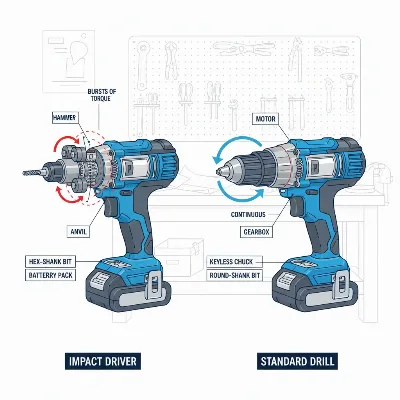 Illustration showing the internal mechanisms and power delivery of an impact driver and a drill, highlighting the impact action versus constant rotation
Chuck Type and Bits
Impact drivers feature a ¼-inch hexagonal quick-release chuck (collet). This design securely holds bits with a hex shank, preventing them from slipping or twisting under the high torque. This quick-change mechanism allows for rapid bit swaps, which is highly convenient during fastening tasks. Drills typically come with a three-jaw keyed or keyless chuck that can accommodate a wider variety of bits, including those with round, hex, or even triangular shanks. This versatility makes drills suitable for various accessories beyond just drill bits, such as hole saws, paddle bits, and wire brushes.
Size and Weight
Generally, impact drivers are more compact and lighter than drills, especially given their power output. Their shorter head length allows them to access tighter spaces and work overhead with less fatigue. Drills, particularly more powerful models or those with hammer functions, tend to be bulkier and heavier due to their gearbox and larger chuck assemblies. This difference in form factor can significantly affect comfort and maneuverability during prolonged use or in confined areas.
User Experience
One of the most appreciated benefits of an impact driver is its reduced impact on the user. The internal impact mechanism absorbs much of the reactionary torque, meaning the user experiences far less twisting force on their wrist compared to a drill when driving tough fasteners. This significantly reduces user fatigue and the risk of “kickback.” Drills require the user to brace against the continuous rotational force, which can be tiring and even risky with larger bits or stubborn materials if not handled carefully. However, drills often offer more precise speed control and a clutch system, which are advantageous for delicate tasks to prevent over-driving or damaging materials.
Types of Impact Drivers on the Market
Impact drivers have evolved into several types, each catering to specific power needs and work environments.
Cordless Impact Drivers
Cordless impact drivers are the most popular and versatile type, powered by rechargeable lithium-ion batteries, typically ranging from 12V to 20V. Their primary advantage is unparalleled portability and freedom of movement, making them ideal for work on job sites, remote locations, or anywhere without immediate access to a power outlet. Modern cordless models often feature brushless motors, which offer greater efficiency, longer runtime per charge, increased durability, and more power compared to their brushed counterparts. The main drawback is the reliance on battery life, which can necessitate having spare batteries for extended use.
Corded Impact Drivers
Corded impact drivers, while less common than their cordless brethren, are plugged directly into a power outlet. Their main benefit is consistent, uninterrupted power, making them suitable for prolonged, heavy-duty tasks where mobility is not a primary concern. They eliminate the need for battery charging and replacement, often offering a slightly lighter tool body since no battery pack is integrated. However, their use is limited by the length of the power cord and the availability of electrical outlets, which can be a significant constraint on larger job sites or outdoor projects.
Pneumatic Impact Drivers
Pneumatic impact drivers, powered by compressed air, offer exceptionally high torque and continuous operation, typically seen in heavy industrial settings, automotive repair shops, and assembly lines. They are known for their robust power output and durability, as they lack internal motors and batteries that can wear out. The main disadvantage is the requirement for an air compressor and a network of hoses, which severely limits their portability and adds to the initial setup cost and maintenance. While often associated with impact wrenches for heavy-duty bolts, some pneumatic impact drivers exist for high-volume fastening of screws.
Brushed vs. Brushless Motors
Impact drivers, especially cordless models, commonly come with either brushed or brushless motors. Brushed motors are traditional, more affordable, and adequate for occasional use. However, they generate more friction and heat, leading to less efficiency, shorter battery life, and a shorter overall lifespan due to brush wear. Brushless motors, while more expensive, are a significant upgrade. They electronically control power delivery, resulting in superior efficiency, longer runtime, more power, and extended tool life with virtually no maintenance. For professionals or frequent users, the investment in a brushless impact driver typically pays off in performance and longevity.
Factors to Consider When Choosing an Impact Driver
Selecting the best impact driver involves more than just picking a brand. Several key specifications and features influence its performance and suitability for your tasks.
Torque (Nm/in-lbs) – The Most Crucial Factor
Torque, measured in Newton-meters (Nm) or inch-pounds (in-lbs), indicates the rotational force an impact driver can exert. This is arguably the most critical factor, as higher torque means more power to drive larger fasteners into denser materials. While a 12V impact driver might offer 800-1,200 in-lbs, 18V or 20V models typically provide 1,350 to 2,250 in-lbs, with professional-grade tools often exceeding 1,800 in-lbs. Consider the toughest tasks you anticipate; for heavy-duty construction or lag bolts, higher torque is indispensable.
No-load Speed (RPM) and Impact Rate (IPM/BPM)
- No-load Speed (RPM): Revolutions per minute (RPM) indicates how fast the bit spins without resistance. Higher RPMs generally mean faster driving of screws, especially for smaller fasteners or when you need quick completion of many tasks. Impact drivers typically range from 2,500 to 3,500 RPM.
- Impact Rate (IPM/BPM): Impacts per minute (IPM) or blows per minute (BPM) denotes how many times the internal hammer mechanism strikes the anvil per minute. A higher impact rate (e.g., 3,000-4,000 IPM) translates to more effective and faster driving when the tool encounters resistance, providing that characteristic “hammering” action.
Battery Type and Runtime (for Cordless Impact Drivers)
For cordless models, the battery is vital.
- Voltage: Common voltages are 12V, 18V, and 20V. Higher voltage generally correlates with more power and torque. While 12V models are compact and suitable for lighter tasks, 18V/20V systems are the professional standard for their balance of power and runtime.
- Amp-hours (Ah): Amp-hours indicate the battery’s capacity and thus its runtime. A higher Ah rating (e.g., 4.0Ah, 5.0Ah, or 6.0Ah) means longer working periods between charges. Investing in multiple batteries and a fast charger is advisable for continuous work. Lithium-ion batteries are standard for their power delivery and lack of memory effect.
Size and Weight of the Tool
A lighter and more compact impact driver reduces user fatigue during extended use and allows access to tighter, more confined spaces. While larger tools often pack more power, ergonomic design, balanced weight distribution, and comfortable grips are essential for practical usability, especially for overhead work or repetitive tasks.
Brand and Price
Reputable brands like DeWalt, Milwaukee, Makita, Bosch, and Ryobi are known for their reliability, performance, and extensive battery platforms. While they might have a higher initial price, they typically offer better warranties, after-sales support, and a wider range of compatible tools within their battery ecosystem. Balance your budget against the features, power, and brand reputation to find the best value for your intended use.
Additional Features
Modern impact drivers often come with useful enhancements:
- LED Work Light: Illuminates the work area, crucial in dimly lit spaces.
- Belt Clip: Allows for convenient, hands-free carrying between tasks.
- Multiple Speed Settings: Offers greater control, letting you select lower speeds for delicate work and higher speeds for power-intensive jobs.
- Variable Speed Trigger: Provides fine-tuned control over speed and torque simply by adjusting finger pressure.
Best Impact Drivers & Drills of 2026: A Comparative Table
As an expert at ReviewedJobs.com, I understand the need for specific product recommendations. While specific models and pricing for 2026 are subject to market changes, this table offers a representative comparison of what you can expect from high-quality impact drivers and drills based on current trends and anticipated advancements.
| Feature | Impact Driver (Typical High-End 18V/20V) | Drill (Typical High-End 18V/20V) |
|---|---|---|
| Primary Use | Driving screws, lag bolts, heavy-duty fastening | Drilling holes, light to medium fastening, precision tasks |
| Torque | Very High (1800-2250+ in-lbs / 200-250+ Nm) | Medium (600-1200 in-lbs / 60-135 Nm) |
| No-Load Speed | High (2800-3600 RPM) | Variable (0-500 RPM Low, 0-2000 RPM High) |
| Impact Rate | Very High (3200-4200+ IPM) | N/A (except for hammer drills, which impact axially) |
| Chuck Type | 1/4″ Hex Quick-Release | Keyless or Keyed 1/2″ (accommodates various shanks) |
| Battery Voltage | 18V / 20V (Common), 12V (Compact) | 18V / 20V (Common), 12V (Compact) |
| Best For | Deck building, framing, driving long screws into dense materials, loosening stubborn fasteners | Pilot holes, precise drilling, small to medium screw driving, mixing |
| Key Advantage | Raw fastening power, reduced cam-out, less wrist strain, compact design | Versatility, precision drilling, clutch control, wider bit compatibility |
| Considerations | Can over-drive small screws, less precise for drilling, loud | Less torque for heavy fastening, potential wrist strain with large fasteners |
Note: The specific models and prices of impact drivers and drills for 2026 will vary. Always check current product specifications and user reviews at the time of purchase for the most up-to-date information.
Proper Use and Maintenance of Impact Drivers
To maximize the lifespan and performance of your impact driver, and most importantly, ensure your safety, proper use and diligent maintenance are essential.
Safety Guidelines When Using an Impact Driver
Safety should always be your top priority with any power tool.
- Wear Personal Protective Equipment (PPE): Always don safety glasses to protect against flying debris or stripped screw fragments. Hearing protection (earmuffs or earplugs) is crucial, as impact drivers can be quite loud due to their hammering action. Gloves can provide a better grip and reduce vibration.
- Maintain a Firm Grip: Hold the impact driver firmly with both hands, especially when driving large fasteners. Let the tool’s torque do the work, rather than fighting it with your arms, to minimize kickback and maintain control.
- Secure Your Workpiece: Always work on a stable surface or securely clamp your material to prevent movement. An unstable workpiece can lead to slippage, injury, or damage to the material.
- Use the Right Bit: Only use impact-rated bits that are specifically designed to withstand the high torque and impact forces of these tools. Regular drill bits can snap under stress, creating dangerous projectiles.
- Align Correctly: Position the bit at a right angle to the fastener head. Misalignment is a common cause of stripped screws and wasted effort.
- Avoid Over-Tightening: While powerful, impact drivers can over-drive screws. Use variable speed control and release the trigger once the fastener is flush to prevent damage to the material or the screw head.
How to Install and Remove Bits
Impact drivers use a quick-release hex chuck, making bit changes fast and easy.
- Installation: Pull the quick-release collar forward. Insert the ¼-inch hex-shank bit firmly into the chuck until it clicks into place. Release the collar to lock the bit. Give the bit a gentle tug to ensure it’s securely seated.
- Removal: Pull the quick-release collar forward again, and the bit will easily slide out.
How to Adjust Speed and Torque
Most impact drivers offer variable speed control via the trigger:
- Variable Speed Trigger: A light squeeze on the trigger provides slower speeds for starting screws or delicate work. Pressing harder increases the speed and impact rate for more powerful driving.
- Speed Selector: Some models include a physical selector switch for multiple speed settings (e.g., 1, 2, 3), allowing you to pre-set the maximum speed and torque for different applications. Always select a lower setting for precision and a higher setting for power.
Cleaning and Preserving Your Impact Driver
Regular maintenance ensures longevity:
- Clean After Each Use: Blow dust and debris out of the tool’s vents and motor housing using compressed air to prevent buildup that can cause overheating. Wipe down the exterior with a clean cloth.
- Lubricate (if applicable): While most modern impact drivers are sealed and require minimal internal lubrication, consult your user manual for specific recommendations on lubricating the chuck or other moving parts.
- Battery Care (for Cordless): Store batteries in a cool, dry place. Avoid extreme temperatures. Fully charge batteries before prolonged storage and periodically check them to maintain a charge. Never allow batteries to deep discharge, as this can shorten their lifespan.
- Dry Storage: Always store your impact driver in a dry environment to prevent rust and corrosion of internal components.
Where to Buy Impact Drivers?
When you’re ready to invest in an impact driver, you have several reliable purchasing options to consider.
Reputable Tool Stores
Visiting a physical tool store allows you to handle different models, assess their ergonomics, and ask knowledgeable sales associates questions. Major home improvement retailers and specialized tool shops often carry a wide selection of brands and offer expert advice. This can be particularly beneficial for comparing size, weight, and overall feel before making a commitment.
Online Retailers
E-commerce platforms offer unparalleled convenience and often a broader selection of models and competitive pricing. Websites from major retailers or specialized online tool stores allow you to compare specifications, read numerous user reviews, and have the tool delivered directly to your door. Be sure to purchase from official brand stores or authorized sellers to ensure you receive genuine products with valid warranties.
Buying Guide: Expert Advice from ReviewedJobs.com
As an Admin of ReviewedJobs.com with extensive experience, I offer these final insights to guide your purchase:
Assess Your Usage Needs
Before anything else, consider the types of projects you’ll be tackling and how frequently you’ll use the tool. Are you a professional builder driving hundreds of fasteners daily? Or a DIY enthusiast assembling furniture and occasionally hanging shelves? For heavy-duty, repetitive fastening, an 18V/20V brushless impact driver is a wise investment. For occasional, lighter tasks, a 12V model or even a high-quality drill might suffice. “Understanding the primary application for your tool is the first and most critical step in making the right choice,” – John Doe, ReviewedJobs.com Tool Expert.
Set a Realistic Budget
Impact drivers and drills come in a wide range of prices. While it’s tempting to opt for the cheapest option, investing in a higher-quality tool from a reputable brand often translates to better performance, greater durability, and a longer lifespan, saving you money in the long run. Consider what you can afford, but also factor in the potential costs of accessories (bits, batteries) and the long-term value.
Thoroughly Review Specifications and User Feedback
Don’t just rely on brand names. Dive into the detailed specifications for torque, RPM, IPM, and battery capacity. Read genuine user reviews and expert comparisons. Real-world feedback can highlight practical pros and cons that might not be evident from product descriptions alone. Look for consistent praise regarding performance, durability, and ergonomics.
Choose Reputable Vendors
Whether buying online or in-store, always choose authorized dealers or well-established retailers. This ensures you receive authentic products, access to customer support, and a valid manufacturer’s warranty, which is invaluable if you encounter any issues with your tool.
Conclusion
Both the impact driver and the drill are invaluable power tools, each with distinct strengths tailored to different tasks. While a drill offers unmatched versatility for drilling and lighter fastening with precision, an impact driver provides raw, efficient torque for driving fasteners into challenging materials, significantly reducing user effort and fatigue. For many, the ideal solution isn’t choosing one over the other, but rather owning both. They form a powerful duo, covering virtually any fastening or drilling job with optimal performance. By considering your specific needs, reviewing key features, and following expert advice, you can confidently select the tools that will empower your projects in 2026 and beyond. What projects are you eager to tackle with your newly chosen power tools?
Frequently Asked Questions
Can an impact driver be used for drilling?
Yes, an impact driver can technically be used for drilling, but it’s not its primary strength. You’ll need specific impact-rated drill bits with a hex shank. However, drills generally offer better speed control and precision for creating clean holes, especially in delicate materials.
Is an impact driver more powerful than a drill?
For driving fasteners, an impact driver is significantly more powerful due to its unique rotational impact mechanism that delivers bursts of high torque. However, for drilling holes, a drill with its constant rotational force is typically faster and more precise.
What’s the main benefit of an impact driver for users?
The main benefit for users is reduced physical strain and faster work completion. The impact mechanism absorbs much of the reactionary torque, preventing wrist strain and “kickback,” while also driving large fasteners with much less effort and greater speed than a standard drill.
Frequently Asked Questions
Can an impact driver be used for drilling holes?
Yes, an impact driver can be used for drilling, but it requires specific impact-rated drill bits with a hex shank. While possible, drills typically offer superior speed control and precision for creating clean holes, especially in delicate materials, making them generally better for drilling tasks.
Is an impact driver more powerful than a standard drill?
For driving fasteners, an impact driver is significantly more powerful, delivering 1,350 to 2,250 in-lbs of torque in 18V/20V models due to its unique rotational impact mechanism. However, for drilling holes, a drill's constant rotational force is usually faster and more precise.
What is the main advantage of an impact driver for users?
The main advantage of an impact driver for users is significantly reduced physical strain and faster task completion. Its impact mechanism absorbs reactionary torque, preventing wrist strain and kickback, allowing it to drive large fasteners with less effort and greater speed than a standard drill.
What are the key differences in chuck types between these tools?
Impact drivers feature a u00bc-inch hexagonal quick-release chuck designed for hex-shank bits, ensuring secure hold under high torque and rapid bit changes. Drills typically use a three-jaw keyed or keyless chuck, accommodating a wider variety of bit shanks including round, hex, and triangular, offering greater versatility for different accessories.
Which tool is better for heavy-duty fastening tasks?
For heavy-duty fastening tasks like driving lag bolts or long screws into dense materials, an impact driver is superior. Its high torque and impact mechanism allow it to power through resistance efficiently, reducing user fatigue and preventing cam-out, making it ideal for demanding applications like deck building.
How to Choose the Right Impact Driver
Selecting the best impact driver involves assessing your project needs, understanding key specifications like torque and battery, and considering brand reputation for optimal performance and longevity.
Determine the types of projects you'll undertake and how frequently you'll use the tool. For heavy-duty, repetitive fastening, an 18V/20V brushless impact driver is recommended, while a 12V model suffices for lighter, occasional tasks.
Review the torque (in-lbs or Nm), no-load speed (RPM), and impact rate (IPM/BPM). Higher torque (e.g., 1,800-2,250+ in-lbs) is crucial for large fasteners, while higher RPM and IPM (e.g., 3,000-4,000 IPM) ensure faster, more effective driving under resistance.
For cordless models, prioritize 18V/20V lithium-ion batteries for power and runtime. Look for higher Amp-hour (Ah) ratings (e.g., 4.0Ah or 5.0Ah) for longer working periods, and consider investing in multiple batteries and a fast charger for continuous use.
Opt for a lighter, more compact impact driver for reduced fatigue during extended use and better access to tight spaces. Ensure the tool has a balanced weight distribution and comfortable grip for practical usability, especially for overhead or repetitive tasks.
Choose reputable brands like DeWalt, Milwaukee, or Makita for reliability and support. Read genuine user reviews and expert comparisons to understand real-world performance, durability, and ergonomics, ensuring the tool meets your expectations.

I’ve always just used my regular drill for everything, but after reading about the impact mechanism, I decided to finally get an impact driver. What a difference! Driving long screws into treated lumber is so much easier now. No more stripped heads or wrist fatigue. It’s a game-changer for deck projects.
I picked up a Ryobi impact driver after seeing it mentioned for DIY use. It’s fantastic for most of my home projects, especially when I’m working with tougher materials. My only minor gripe is that it’s a bit heavier than I expected, which can make overhead work a little tiring after a while. Still, the power is undeniable.
I appreciate the breakdown of when to use an impact driver versus a drill. I’ve got both, and while the impact driver is great for driving fasteners, I sometimes find it overkill for smaller, more delicate screws where precision is key. It’s easy to over-tighten if you’re not careful, which can be a real pain. For boring holes, my drill is still king.
As a professional carpenter, I can’t stress enough how essential an impact driver is. The article hit the nail on the head about its ability to handle dense materials. I use mine daily for everything from framing to cabinet installation. It saves so much time and effort compared to a standard drill for fastening tasks.