In the demanding world of plumbing, tight spaces and stubborn fasteners are a daily reality. A standard drill or impact driver often falls short, struggling to access confined areas beneath sinks, behind toilets, or within wall cavities. This is where a right angle impact driver becomes an indispensable tool, transforming challenging jobs into manageable tasks. As a technician with over a decade of hands-on experience in the power tool industry, I understand the critical difference the right equipment makes. This guide will help you navigate the features, benefits, and top models of right angle impact drivers to optimize your plumbing workflow in 2026.
What is an Impact Driver?
An impact driver is a specialized power tool designed to drive screws and fasteners with high torque and efficiency. Unlike a conventional drill, which applies continuous rotational force, an impact driver utilizes a hammering mechanism that delivers rapid, powerful bursts of rotational impact. This percussive action allows it to drive long screws and lag bolts into dense materials much faster and with less effort, preventing cam-out and stripping of screw heads. They typically feature a 1/4-inch hex chuck, ideal for quick changes of screwdriver bits and specialized impact-rated accessories.
What is a Right Angle Impact Driver?
A right angle impact driver takes the core functionality of a standard impact driver and reconfigures it into a compact, L-shaped design. The chuck, where the bit is inserted, is positioned at a 90-degree angle to the tool’s body and handle. This unique configuration significantly reduces the tool’s head height and overall profile, allowing plumbers to easily reach and fasten in extremely tight and awkward spaces that a traditional pistol-grip impact driver simply cannot access. For plumbing professionals, this means effortless work in cramped cabinets, between floor joists, or around existing pipework, making it invaluable for installing fixtures, securing piping, or repairing components in challenging environments.
Cordless vs. Pneumatic Right Angle Impact Drivers for Plumbing
Choosing between cordless and pneumatic right angle impact drivers depends heavily on the specific demands of your plumbing work. Both types offer distinct advantages and disadvantages that influence portability, power, and convenience.
Cordless Right Angle Impact Drivers
Cordless right angle impact drivers, powered by rechargeable lithium-ion batteries, offer unparalleled portability and freedom of movement. Plumbers can work in remote areas without needing access to power outlets or air compressors, making them ideal for new construction sites, outdoor repairs, or jobs in properties with limited infrastructure. Modern cordless models, especially those with brushless motors, provide excellent power-to-weight ratios, long battery life, and variable speed control for precision. They are generally quieter than their pneumatic counterparts and require less maintenance, primarily focusing on battery care. However, their power output, while impressive for most plumbing tasks, may not match the highest torque pneumatic models, and battery runtime can be a limitation on extensive projects, requiring spare batteries or charging breaks.
Pneumatic Right Angle Impact Drivers
Pneumatic right angle impact drivers, driven by compressed air, are renowned for their consistent high torque and speed. They are often the go-to choice for heavy-duty applications that demand maximum power to break loose rusted bolts or drive large fasteners into very dense materials repeatedly. Since they don’t carry a battery, pneumatic models are often lighter and more compact for their power output. They can run continuously as long as there is an air supply, making them suitable for workshop environments or jobs where a compressor is readily available. The main drawbacks include the need for an air compressor and hoses, which limits portability and can be cumbersome. They also typically require more regular maintenance, such as oiling, and can be significantly louder.
Comparing Cordless and Pneumatic for Plumbers
For most plumbers, especially those doing residential or light commercial work, a cordless right angle impact driver often provides the best balance of power and convenience. The mobility and quick setup are invaluable on diverse job sites. While pneumatic options offer superior brute force for specific high-torque demands, the practicalities of managing an air compressor usually outweigh the power benefits for everyday plumbing tasks. Cordless technology has advanced significantly, with 12V and 18V systems delivering ample torque for securing pipe hangers, assembling fittings, and driving screws in tight spots without the hassle of hoses.
Key Factors When Choosing a Right Angle Impact Driver for Plumbing
Selecting the ideal right angle impact driver involves considering several technical specifications and practical aspects to ensure it meets the unique demands of plumbing work.
Torque – The Most Crucial Factor
Torque, measured in inch-pounds (in-lbs) or Newton-meters (Nm), indicates the rotational force an impact driver can apply. For plumbers, sufficient torque is essential for driving various fasteners into wood studs, metal framing, or securing heavy-duty pipe clamps. While right angle impact drivers generally offer less torque than full-sized impact drivers, a range of 500-1000 in-lbs is typically adequate for most plumbing applications. Tools with higher torque capabilities provide more power for stubborn fasteners but can also be overkill for smaller screws, potentially leading to stripped heads if not carefully controlled.
No-Load Speed and Impact Rate
- No-Load Speed (RPM – Revolutions Per Minute): This refers to how fast the chuck spins without resistance. Higher RPMs allow for faster driving of fasteners, which is beneficial when you have many screws to install.
- Impact Rate (IPM – Impacts Per Minute): This indicates how many times the hammering mechanism engages per minute. A higher IPM translates to more efficient driving, especially into tougher materials, by applying more percussive force.
Both speed and impact rate contribute to efficiency. A tool with variable speed control is highly advantageous, allowing you to match the speed and power to the specific task, from delicate fastening to driving robust lag bolts.
Battery Type and Runtime (For Cordless Tools)
For cordless models, the battery’s voltage (12V, 18V, 20V Max, 24V) affects the tool’s overall power and runtime. Higher voltage typically means more power. Amp-hours (Ah) denote battery capacity, directly influencing how long the tool can operate on a single charge. Plumbers often benefit from higher Ah batteries (e.g., 4.0Ah or 5.0Ah) for extended use, especially when working on multiple jobs without frequent recharging. Brushless motors also improve battery efficiency and tool longevity.
Size and Weight of the Tool
Given the nature of plumbing work, the physical dimensions and weight of the right angle impact driver are critical.
- Head Height/Length: The smaller the head, the better the access into extremely tight spaces. Look for models with a compact head profile.
- Overall Length: A longer body might help with reach in some scenarios, but too long can be awkward in confined areas.
- Weight: A lightweight tool (typically 2-4 lbs without battery) reduces user fatigue during prolonged overhead work or when maneuvering in awkward positions.
Brand and Price
Reputable brands like Milwaukee, Makita, and SKIL offer reliable and durable right angle impact drivers, often backed by extensive battery platforms and warranties. While premium brands might have a higher initial cost, they typically offer superior performance, build quality, and a wider ecosystem of compatible tools. Consider your budget, but also factor in long-term value, tool reliability, and the availability of service and parts.
Top Right Angle Impact Drivers for Plumbers 2026
Here’s a comparison of some of the best right angle impact drivers suitable for plumbing professionals, based on their specifications and suitability for tight-space fastening.
| Product Name | Voltage | Max Torque (in-lbs) | No-Load Speed (RPM) | Impact Rate (IPM) | Head Height | Weight (Bare Tool) | Key Pros | Key Cons |
|---|---|---|---|---|---|---|---|---|
| Milwaukee M18 Right Angle Impact Driver (48-2667) | 18V | 675 | 0-2,250 | 0-3,400 | Low-profile | ~2.2 lbs | Excellent power for an RA driver, durable build, M18 battery ecosystem | Slightly heavier than 12V models, older model so may be harder to find |
| SKIL 12V Brushless 1/4 In. Hex Right Angle Impact Driver (RI574502) | 12V | 900 | 0-2,700 | 3,750 | Compact | 2.49 lbs | High torque for 12V, brushless motor, fast charging, lightweight | Smaller battery ecosystem than major brands |
| Milwaukee M12 1/4″ Hex Right Angle Impact Driver (2467-20) | 12V | 600 | 2,150 | N/A | Ultra-short | Not specified | Extremely compact head, lightweight, M12 battery ecosystem | Lower torque than some 12V competitors, brushed motor |
| Makita 18V LXT 1/4″ Angle Impact Driver (DTL061Z / XLT01Z) | 18V | 530 | 0-2,000 | 0-3,000 | 2-1/8″ (53mm) | ~3.1 lbs | Very compact head, 360° rotatable, excellent ergonomics, 18V power | Torque is lower compared to some 18V competitors |
> “In plumbing, access is king. A right angle impact driver isn’t just a convenience; it’s often the only tool that can get the job done efficiently and safely in the tightest spots.” – Admin, ReviewedJobs.com, Impact Driver Specialist
How to Properly Use and Maintain Your Right Angle Impact Driver
Proper usage and maintenance extend the life of your tool, ensure safety, and optimize performance.
Safety Tips for Using an Impact Driver
- Wear Personal Protective Equipment (PPE): Always use safety glasses to protect against flying debris. Gloves can improve grip and reduce vibration. Hearing protection is recommended, especially for prolonged use, as impact drivers can be loud.
- Secure Your Grip: Right angle drivers can exert significant torque. Maintain a firm, two-handed grip whenever possible to control the tool, especially when working at odd angles or with stubborn fasteners.
- Choose the Right Bit: Always use impact-rated bits that are designed to withstand the high torque and percussive action of an impact driver. Using standard drill bits can lead to breakage and injury.
- Clear the Work Area: Ensure there are no loose materials, wires, or pipes that could interfere with the tool or cause kickback.
Attaching and Removing Bits
Right angle impact drivers typically use a 1/4-inch hex quick-change chuck. To insert a bit, simply push it firmly into the chuck until it locks into place. Some models require pulling a collar back. To remove, pull the collar back (if applicable) and pull the bit out. Ensure the bit is fully seated to prevent it from wobbling or falling out during use.
Adjusting Torque and Speed
Many right angle impact drivers feature variable speed triggers and multiple torque/speed settings.
- Variable Speed Trigger: Feather the trigger for slower speeds and more control when starting a fastener or working with delicate materials. Squeeze fully for maximum speed and power on tough jobs.
- Mode Settings: Use lower torque settings for smaller screws or softer materials to prevent overdriving or stripping. Higher settings are for larger fasteners and harder materials. Experiment with settings on scrap material if unsure.
Cleaning and Storage
- Regular Cleaning: After each use, wipe down the tool with a dry or slightly damp cloth to remove dust, dirt, and debris. Pay attention to vents to ensure proper airflow and prevent overheating. Avoid using harsh chemicals.
- Battery Care (for Cordless): Store batteries in a cool, dry place away from extreme temperatures. Do not store fully discharged or fully charged for extended periods; aim for a partial charge (e.g., 50%) for long-term storage.
- Proper Storage: Store your impact driver in its case or a designated toolbox to protect it from damage and keep it clean. Avoid dropping the tool, as internal components can be sensitive to impact.
Where to Buy Right Angle Impact Drivers
Acquiring a quality right angle impact driver is an investment in your efficiency and professionalism. There are several reliable avenues for purchasing these specialized tools.
Authorized Dealers and Specialty Tool Stores
Purchasing from authorized dealers or dedicated power tool stores offers several benefits. These outlets typically have knowledgeable staff who can provide expert advice, demonstrate tools, and help you compare models. They often carry the latest models, genuine accessories, and may offer better warranty support and after-sales service. Brands like Milwaukee, Makita, and SKIL have a network of such dealers.
Online Retailers
Major online retailers and e-commerce platforms provide a vast selection, competitive pricing, and the convenience of home delivery. You can easily compare specifications, read user reviews, and often find bundle deals. However, ensure you purchase from reputable sellers to avoid counterfeit products and verify their return and warranty policies. Always check the seller’s ratings and read recent reviews before making a purchase.
Buying Guide: Expert Advice from ReviewedJobs.com
As an expert with practical experience, I offer these tailored recommendations to help you make the best choice for your plumbing toolkit.
Assess Your Specific Plumbing Needs
Before making a purchase, consider the types of jobs you frequently encounter. Do you primarily work in extremely tight spaces, or do you need more brute force for larger fasteners? Are you mostly doing residential, light commercial, or heavy-duty industrial plumbing? Your typical tasks will dictate the required torque, head size, and battery voltage. A dedicated right angle impact driver is indispensable for cramped areas, while a more powerful standard impact driver might suffice if tight access is less frequent, perhaps complemented by a right-angle attachment for occasional use.
Set a Realistic Budget
Right angle impact drivers vary in price based on brand, power, and features. Establish a budget that balances upfront cost with long-term value. Investing in a durable, high-performance tool from a reputable brand will often save money in the long run by reducing downtime, increasing efficiency, and avoiding premature replacements. Consider bare tool options if you already own compatible batteries and chargers from a preferred brand.
Review Specifications and User Feedback
Always delve into the detailed specifications (torque, RPM, IPM, weight, head dimensions) and compare them across different models. Pay close attention to real-world user reviews, particularly from other plumbers or tradespeople who use the tools in similar conditions. Their experiences can provide invaluable insights into the tool’s ergonomics, reliability, and true performance in challenging scenarios. Look for comments on battery life, ease of bit changes, and how well it handles specific fasteners common in plumbing.
Choose Reputable Vendors
Regardless of whether you buy online or in-store, always prioritize reputable vendors. This ensures you receive authentic products, valid warranties, and access to customer support should you encounter any issues. Trustworthy suppliers also often provide better product descriptions and accurate specifications, which are crucial for making an informed decision.
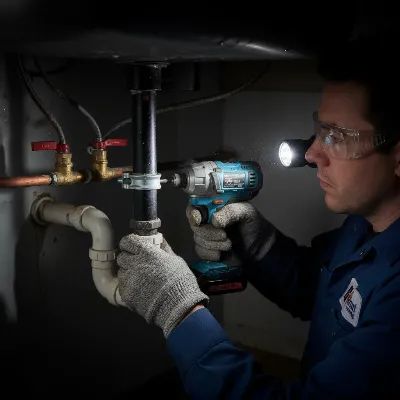 A plumber in a blue uniform using a compact right angle impact driver to fasten a pipe clamp under a sink in a very confined space, with plumbing pipes and fittings visible.
Conclusion
For plumbers operating in the tight, often unforgiving environments of modern construction and repair, the right angle impact driver is not merely a specialized tool but a necessity. Its unique design and powerful fastening capabilities make quick work of tasks that would otherwise be impossible or incredibly time-consuming with conventional tools. By prioritizing factors such as torque, compact head size, battery efficiency, and brand reliability, professionals can select a tool that significantly enhances productivity and reduces physical strain. Whether you opt for the robust power of an 18V model like the Milwaukee M18 or the ultra-compact agility of a 12V system such as the SKIL or Milwaukee M12, investing in the best right angle impact driver for your needs in 2026 will undoubtedly improve your efficiency on every job. What tight spots will you conquer next with your new right angle impact driver?
Frequently Asked Questions
What makes a right angle impact driver different from a right angle drill?
A right angle impact driver uses a hammering mechanism to deliver high rotational force (torque) in quick bursts, ideal for driving screws and fasteners. A right angle drill provides continuous rotational power primarily for drilling holes. While both have a 90-degree head for tight access, the impact driver excels at fastening, while the drill is for drilling.
Can I use regular drill bits with a right angle impact driver?
No, it is strongly recommended to only use impact-rated hex shank bits with a right angle impact driver. Regular drill bits are not designed to withstand the percussive forces and high torque of an impact driver and can break, posing a safety risk and damaging the bit or fastener.
How much torque is generally sufficient for plumbing tasks?
For most plumbing tasks like securing pipe straps, mounting fixtures, or assembling supports, a right angle impact driver with 500-1000 inch-pounds of torque is usually sufficient. For heavier-duty applications or very stubborn fasteners, higher torque models or an impact wrench might be necessary, but those are often bulkier.
Are 12V or 18V (or 20V Max) right angle impact drivers better for plumbers?
Both 12V and 18V/20V Max systems have their place. 12V tools are typically more compact and lighter, offering superior access in extremely tight spots and reducing fatigue. 18V/20V Max tools generally provide more power and longer runtime for demanding tasks. The best choice depends on your specific balance of required power vs. tool size.
How do I maintain the battery life of my cordless right angle impact driver?
To prolong battery life, avoid fully discharging or overcharging the battery. Store batteries in a cool, dry place at a partial charge (around 50%) for long periods of inactivity. Use the charger specifically designed for your battery pack and avoid exposing batteries to extreme temperatures.
